
Why a Simple Notebook Beats Any App
Every family in western Kentucky has a weather watcher. Maybe it is a grandfather who taps the barometer by the back door, an aunt who swears her knee knows when rain is coming, or a neighbor who can look at the western sky and say, “We are going to get it tonight.” That kind of knowledge is a form of wisdom, and it only survives when somebody hands it down. This week, we want to encourage you to do exactly that: pass it on, starting with a pencil and a cheap notebook.
Here at Weather & Wisdom, host David Powell and co-host and meteorologist Mark Booker talk often about how the best forecasters never stop observing. Radar, satellites and computer models are powerful tools, but they all began with ordinary people writing down what they saw. A weather journal is the oldest and most approachable way to join that tradition, and it works for a seven-year-old and a seventy-year-old alike.
What You Need to Get Started
Almost nothing. A notebook or a calendar with big squares, a pencil, and a spot where you can see the sky. A porch, a kitchen window or the end of the driveway all work. If you want to go a step further, an inexpensive outdoor thermometer placed in the shade, away from brick walls and pavement, will give you a better reading than one stuck in direct sun. A basic rain gauge, a straight-sided container with markings, can be fun for kids, though you can skip it and simply note whether it rained.
Five Things Worth Writing Down Each Day
- The date and time of your observation. Picking the same time each day, such as before the school bus or after supper, makes your notes easier to compare.
- The temperature. Write the number and how it felt, because 40 degrees with wind and 40 degrees with sunshine are two very different days.
- The sky. Clear, partly cloudy, or overcast? If you can name a cloud type, such as cumulus, stratus or cirrus, even better.
- The wind. Which direction is it coming from, and is it calm, breezy or gusty? Tying a strip of cloth or ribbon to a fence post makes this easy.
- Anything unusual. First frost, the first robin, a ring around the moon, the day the leaves finally let go, or a morning of thick fog in the valley.
Turning Observation Into Understanding
After a couple of weeks, patterns start to appear. You may notice that when the wind shifts around to the south and clouds thicken, the next day tends to be warmer and damper, and that a cold front often brings a shift to the northwest with clearing skies behind it. This is a normal pattern in the middle latitudes, and it is exactly the kind of thing a meteorologist reads off a weather map. Seeing it in your own handwriting makes it stick far better than reading about it.
A few years from now, you will be able to flip back and say, “We had our first frost on this date last year,” and compare it with the current season. Just remember that a few years of personal notes are a small sample. They are wonderful for curiosity and for planning the garden, but they are not the same as the official climate records kept by the National Weather Service.
Old Sayings: Keep the Fun, Check the Facts
Part of the joy of a family weather journal is collecting the sayings you grew up with. Some have real science behind them, and some are just charming. “Red sky at night, sailor’s delight” has a basis in how weather systems generally move from west to east in our part of the world, but it is not a guarantee. Other sayings, like predicting a whole winter from the width of a caterpillar’s stripe, have not held up when tested. A good approach is to write the saying down, then record what actually happened. Over a season or two, your family can run its own friendly experiment, which is a lesson in honest observation in itself.
Ways to Make It a Family Habit
- Give each child a job. One reads the thermometer, one checks the sky, and one writes it down. Rotate the jobs weekly.
- Draw the sky. Younger kids can sketch the clouds or color a square blue, gray or yellow instead of writing words.
- Add a monthly summary. Count the sunny, cloudy, rainy and windy days at the end of each month and make a simple chart.
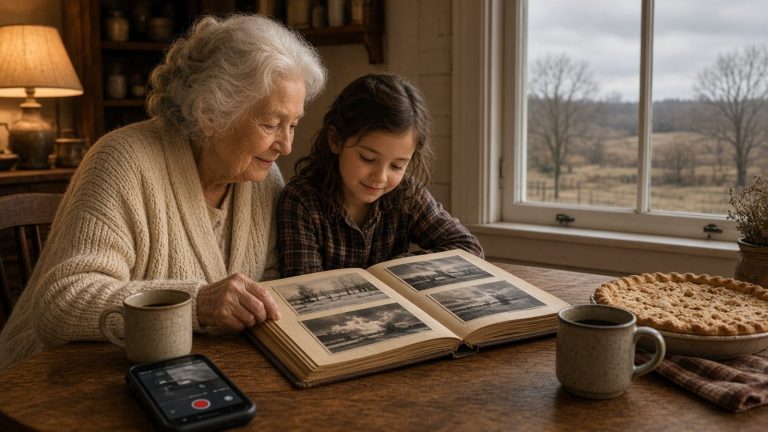
- Invite grandparents to share a memory. Ask about the biggest snow, the hottest summer or a storm they remember, and write it on the page for that date. Memories are not official records, but they are priceless family history.
- Make a seasonal page. Note when the first spring peepers sing, when the tobacco and corn fields change, and when the first hard freeze arrives.
The Wisdom Side: Patience, Attention and Humility
Weather teaches lessons that reach well beyond the sky. Watching it day after day builds patience, because you cannot hurry a front. It builds attention, because the details are small and easy to miss. And it builds humility, because even the experts get surprised now and then, which is why forecasts carry a chance of rain instead of a promise. Children who learn to look up and notice tend to carry that habit into everything else they do.
A Word on Safety
A journal is a learning tool, not a replacement for official warnings. When severe weather is possible, rely on your NOAA Weather Radio, your phone’s emergency alerts and trusted local forecasts, and follow your family’s safety plan. Never go outside to “observe” a storm. Do your sky-watching and note-taking from a safe place, and save the journal entry for after the danger has passed.
Start Today
You do not need to wait for a new year or a special season. Grab a notebook this evening, step outside, and write down today’s date, the temperature and what the sky looks like over Hopkinsville. Tomorrow, do it again. Before long, you will have built something that no app can give you: a personal record of the place you call home, and a way to share the wisdom of watching the weather with the next generation.

Comments
No comments yet. Start the conversation!