Most of us picture a tornado the way it shows up in photographs: a funnel hanging from a dark afternoon sky, visible for miles across open farmland. Here in western Kentucky, the reality is often very different. Some of the most dangerous tornadoes in our region’s history have come after dark, when nobody could see them coming and many people were already in bed. As we head into the late-fall and winter stretch of our second severe weather season, it is worth talking honestly about why nighttime tornadoes are so deadly and what every household in Christian County and the surrounding area can do about it.
We have lived this lesson
According to the National Weather Service’s service assessment of that event, the long-track tornado that devastated Mayfield, Princeton, Dawson Springs and other communities began near Woodland Mills, Tennessee, at 8:49 p.m. CST and stayed on the ground for a continuous 165.6 miles until 11:47 p.m. CST near Falls of Rough. It was rated EF-4, and 57 people lost their lives across the NWS Paducah warning area, the most in that office’s history. The same storm system produced another long-track tornado that tracked through northwest Tennessee into Christian and Todd counties.
That storm arrived in December, in the dark, on a Friday night. Every one of those details matters, because they are exactly the conditions that make tornadoes most dangerous.
What the research says about tornadoes after dark
A widely cited 2008 study led by Walker Ashley of Northern Illinois University, published in the American Meteorological Society journal Weather and Forecasting, looked at U.S. tornadoes from 1950 to 2005. Only about 27 percent of those tornadoes happened at night, yet they accounted for about 39 percent of tornado deaths and 42 percent of killer tornado events. Tornadoes in the overnight window, from midnight to sunrise, were about 2.5 times as likely to kill as daytime tornadoes.
The researchers pointed to a few simple reasons:
- You can’t see them. Darkness, rain and low clouds hide the tornado from the public and from trained storm spotters.
- People are asleep. An outdoor siren or a TV warning does no good if nobody is awake to hear it.
- People are home. At night most of us are in houses and mobile homes rather than schools, stores and workplaces built to sturdier standards. The study found that nearly 61 percent of mobile home tornado deaths happened at night.
The study also found that the South’s high share of nighttime tornadoes is an important reason the region has such a high tornado death rate. That is our neighborhood.
Why our fall and winter storms so often come at night
In the spring on the Plains, storms tend to fire in the afternoon heat. Our cool-season severe weather works differently. Fall and winter outbreaks in the Mid-South are usually driven by strong storm systems and powerful winds aloft rather than by afternoon heating alone. Those ingredients do not shut off at sunset, so storms can keep going, or even get organized, well into the evening and overnight hours. Shorter days in November and December also mean that “after dark” starts before many people have finished supper.
Your nighttime tornado plan
The good news is that the danger of a nighttime tornado comes mostly from not knowing it is there, and that is something every family can fix before storm night.
1. Have a way to be woken up
Outdoor warning sirens are designed to alert people outdoors. They are not meant to wake you up inside a closed house with the fan running. Make sure you have at least two ways to receive a warning that can wake you up:
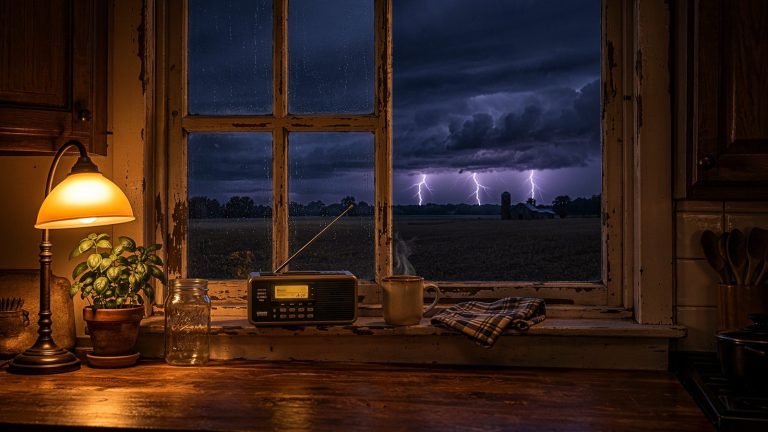
- A NOAA Weather Radio with battery backup, programmed for your county, set to alert mode and placed where you will hear it from bed.
- Wireless Emergency Alerts turned on in your phone’s settings. Keep the phone charged and nearby, and check that “Do Not Disturb” or sleep modes will still let emergency alerts through.
- A trusted weather app or local coverage that sends alerts for your location, plus Weather & Wisdom’s own notifications and live coverage when storms threaten.
2. Check the forecast before bed
On days when the Storm Prediction Center has our area in a risk for severe weather, look at the timing before you go to sleep. If storms are expected overnight, consider staying up a little later, sleeping closer to your shelter spot, or having one adult in the house stay alert until the line passes.
3. Know your spot and prepare it now
Pick your shelter in daylight, not during the warning. Go to the lowest floor, in an interior room or hallway away from windows, such as a bathroom, closet or basement. Put a few things there ahead of time: sturdy shoes for everyone, a flashlight, and helmets or pillows and blankets to protect heads and necks. Broken glass and debris make shoes one of the most overlooked items in a nighttime emergency.
4. Mobile home? Leave early
Mobile and manufactured homes offer little protection from tornadoes, and the research shows how heavily that risk falls at night. If you live in one, decide ahead of time where you will go, such as a friend’s or family member’s sturdy home or a community shelter, and go when a watch or severe threat is in place for the evening, not after the warning is already issued.
5. Don’t wait to see it
At night you will not see the tornado, and you may not hear the famous freight-train roar until it is right on top of you. When a tornado warning is issued for your location, act immediately. Do not step out onto the porch to look.
6. Look out for your neighbors
Older neighbors, people living alone, and families who do not follow the weather closely are among the most vulnerable on storm nights. A simple phone call or a text before bed on a high-risk evening is the kind of small kindness that can save a life.
The bottom line
Nighttime tornadoes are not more powerful than daytime tornadoes. They are more dangerous because they catch people unaware. Every step above is about closing that gap: getting the warning, getting awake and getting to safety in the minutes that matter. Take ten minutes this week to set up your weather radio, check your phone alerts and walk your family through your shelter plan. When storms do threaten western Kentucky, David Powell and Mark Booker will be here with you, but the plan you make tonight is what keeps your family safe.
Comments
No comments yet. Start the conversation!